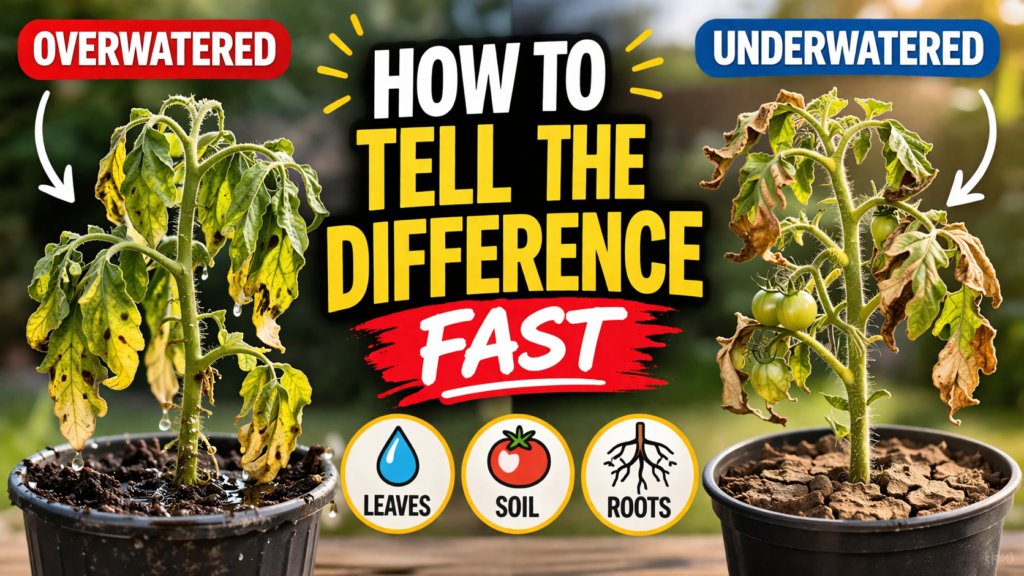
If your tomato plant looks sick, the first question to answer is simple: too much water or not enough? These two problems cause almost identical symptoms — wilting, yellowing, drooping leaves — but the fixes are completely opposite. Water a thirsty plant and it bounces back. Water a drowning plant and you make everything worse.
This guide gives you a clear, no-guesswork way to tell the difference and fix it fast.
Why Overwatering and Underwatering Look So Similar
Both problems stress the plant’s roots, which is why the symptoms overlap so much. When roots sit in soggy soil for too long, they stop functioning and can no longer deliver water to the rest of the plant — so an overwatered tomato wilts for the same reason an underwatered one does. The roots just cannot do their job.
The difference is in the soil, the leaves, and the timing. Once you know what to look for, you can diagnose the problem in about 30 seconds.

The Fastest Way to Tell the Difference
Before you look at the plant at all, check the soil.
Push your finger two inches into the soil near the base of the plant. This single step tells you almost everything.
Wet or cool and damp — you are likely overwatering. Set the hose down and step away.
Dry and pulling away from the container edges — your plant is thirsty. Water deeply right now.
Somewhere in between — check the plant symptoms below to figure out what is going on.
Overwatered vs Underwatered: Side by Side
Soil
Overwatered: Wet, soggy, possibly smells sour or musty
Underwatered: Dry, cracked, pulling away from pot edges, dusty
Leaves
Overwatered: Soft, limp, may feel slightly swollen or waterlogged
Underwatered: Dry, crispy at the edges, may feel papery
Leaf color
Overwatered: Yellowing starting from the bottom of the plant upward
Underwatered: Dull green, may brown at the tips and edges
Wilting pattern
Overwatered: Wilting persists even when soil is wet — does not recover after watering
Underwatered: Wilts during the hottest part of the day, perks back up in the evening or after watering
Stems
Overwatered: Soft or mushy near the base, may look dark
Underwatered: Firm but dry, may look slightly shrunken
Recovery speed
Overwatered: Slow — takes days to weeks depending on root damage
Underwatered: Fast — most plants recover within hours of a good deep watering


What Overwatered Tomato Plants Look Like in Detail
An overwatered tomato plant is one of the more confusing things in the garden because it genuinely looks like it needs water. The leaves droop. The plant looks sad. Your instinct is to water it.
Do not.
Here is what you are actually seeing when a tomato is overwatered:
Downward curling leaves that feel soft and almost spongy instead of crisp. This is different from heat stress curling, which tends to roll the leaf edges inward lengthwise.
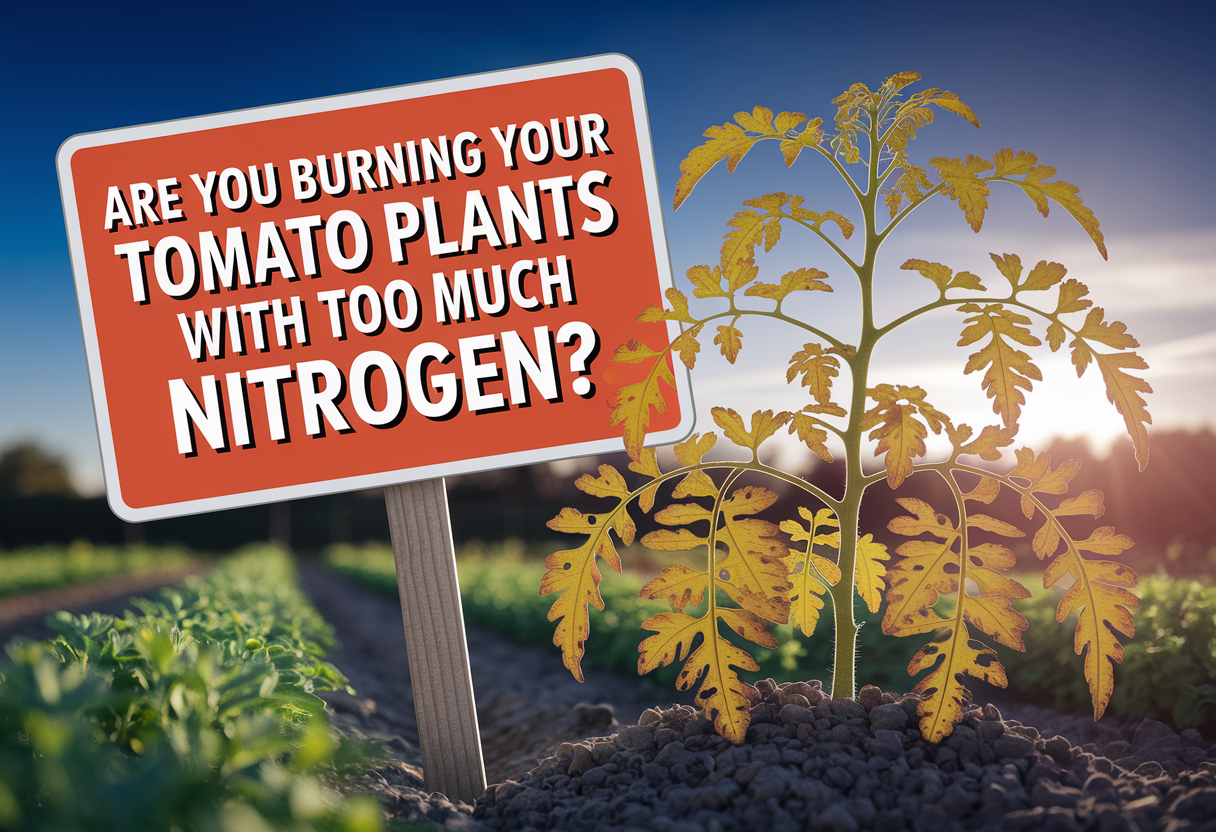
Yellowing from the bottom up. Lower leaves go yellow first. This happens because waterlogged roots cannot absorb nitrogen and other nutrients even when they are present in the soil.
Mushy or dark stems near the soil line. This is a sign that root rot has set in. If you see this, the situation is serious and you need to act fast.
Soil that stays wet for days after watering. Healthy soil in a container should dry out meaningfully within 2–3 days. If it is still soggy on day four, your drainage is poor or you are watering too often.
A sour or rotten smell from the soil. Healthy soil smells earthy. Waterlogged soil that has lost oxygen starts to smell like something is decaying — because it is.
What Underwatered Tomato Plants Look Like in Detail
Underwatering is more straightforward to identify and easier to fix. Tomatoes are about 95% water, so they feel it quickly when the supply runs low.
Wilting that follows the heat of the day. An underwatered plant will look fine in the morning, start to droop by early afternoon, and partially recover by evening. This daily cycle is a classic sign of not enough water.
Crispy, brown leaf edges. Unlike the soft yellowing of overwatering, underwatering causes dry, papery browning at the tips and edges of leaves — starting with the older lower leaves and working upward.
Dry, hard soil. The soil will feel completely dry more than two inches down. In containers, it may pull away from the sides of the pot, creating a gap that actually causes water to run straight down the sides and out the bottom without ever soaking the root zone.
Smaller than normal fruit. Tomatoes that go through water stress during fruit development end up smaller, mealy, or bland. Consistent water is one of the biggest factors in fruit size and flavor.
Blossom drop. When water stress hits during flowering, the plant drops blossoms before they can set fruit. This is the plant protecting itself — it cannot support fruit development without enough water.
How to Fix Overwatered Tomato Plants
- Stop watering immediately. Give the soil time to dry out. Depending on conditions this may take several days.
- Improve drainage if needed. If you are in containers, check that drainage holes are not blocked. If they are, clear them or repot into a container with better drainage. For in-ground plants, gently loosen the soil around the base of the plant with a fork to help air get back to the roots.
- Remove damaged leaves. Prune off any yellow, mushy, or clearly dead leaves. This reduces the burden on stressed roots and improves airflow around the plant.
- Check for root rot. If the plant is in a container, tip it out carefully and look at the roots. Healthy roots are white or light tan. Rotted roots are brown, black, and mushy. If rot is limited to a few roots, trim them off with clean scissors and repot in fresh dry mix. If most of the root ball is rotted, the plant may not recover.
- Hold off on fertilizer. Do not add fertilizer to a waterlogged plant. Roots that are already struggling cannot process nutrients, and fertilizer salts will add stress on top of stress.
- Be patient. A plant recovering from overwatering does not bounce back overnight. Give it 5–7 days before deciding whether it is going to pull through.
How to Fix Underwatered Tomato Plants
- Water deeply right now. Do not just dampen the surface. Water slowly and thoroughly until it drains freely from the bottom of containers or soaks in fully for in-ground plants. You want the entire root zone saturated.
- Do not overcompensate. After a deep watering, resist the urge to water again the next day out of guilt. Let the soil dry to about two inches before watering again.
- Check your watering frequency. Most tomato plants in containers need water every 1–3 days during summer depending on heat, pot size, and sun exposure. In-ground plants typically need deep watering 2–3 times per week. Small pots in full sun may need daily water during a heat wave.
- Mulch around the base. A 2–3 inch layer of straw or wood chip mulch around your tomato plants dramatically reduces moisture loss from the soil surface. This is one of the single most effective things you can do to maintain consistent soil moisture.
- Consider drip irrigation. If you regularly forget to water or travel during the season, a drip irrigation system delivers consistent moisture directly to the root zone on a timer. It essentially solves the underwatering problem permanently.
Can a Plant Be Both Overwatered and Underwatered?
It sounds impossible but it happens more than you would think — especially in containers.
Here is how: you water a container plant, the water hits dry compacted soil or runs straight down the gap between the dry root ball and the pot wall, and drains out the bottom without ever soaking into the root zone. The plant is technically being watered but the roots are not getting it.
The fix is to water slowly and check that the soil is actually absorbing moisture. For containers that have gotten very dry, bottom watering works well — set the pot in a shallow tray of water for 20–30 minutes and let the soil draw moisture up from below.
The Tools That Take the Guesswork Out
The fastest way to stop second-guessing your watering is to measure instead of guess. A 4-in-1 soil meter reads soil moisture instantly so you know before you water whether the plant actually needs it. It also reads pH, light, and temperature — four problems solved with one cheap tool.
For growers who want to automate the whole thing, a drip irrigation system with a timer removes the daily decision entirely. Set it up once and your watering schedule runs itself.


Watering Schedule That Works for Most Tomato Growers
There is no single universal schedule because container size, weather, soil type, and plant size all affect how fast moisture depletes. But here is a practical starting framework:
Containers in full sun (summer): Check daily, water when top 2 inches are dry. During heat waves this may mean daily watering for large plants.
Raised beds: Water deeply 2–3 times per week. More during hot dry stretches, less during cool or rainy periods.
In-ground garden beds: Deep watering 1–2 times per week is usually enough once plants are established and mulched. New transplants need more frequent watering until roots establish.
Always water in the morning at the base of the plant. Morning watering gives foliage time to dry during the day, which reduces disease pressure. Evening watering leaves leaves wet overnight, which invites fungal problems.

Related Articles Worth Reading
- Signs of overwatering tomato plants and what to do next
- The real reason your tomato plants are turning yellow
- Tomato leaves curling down — don’t panic, try this first
- Best soil mixture for growing tomatoes in containers
- How to prepare soil for tomatoes the right way
About the Author
Mike Callahan has grown tomatoes in backyard raised beds and containers for over a decade. He has made just about every watering mistake possible and now writes practical growing guides for home gardeners who want real answers without the fluff.
As an Amazon Associate we earn from qualifying purchases through some links in our articles.